PowerDesigner System Model
20 May 1996 updated
Concept:
This diagram shows how PowerDesigner addresses the layers and slices of
information systems architectures.
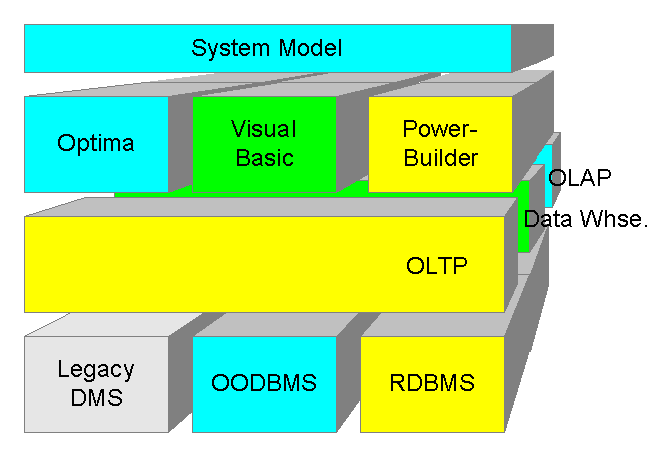
Color Key:





Open standards
- The tool should remain as "open" as possible not tying our
organization to proprietary standards that may become outdated by industry
and technology changes.
- Open repository connectivity rather than proprietery interfaces to
specific products.
Integrated system modeling
There is a great desire for the product to be enhanced to support the
total lifecycle development process, from Strategic Planning to Implementation/
Maintenence. This includes incorporating more process with the data modelling.
(Functional Decomposition, event modelling, etc.)
Process-to-Data integration
- We are working to implement a comprehensive metrics program across
our account, with size being measured by function points. Support in the
application modeler or process modeler for function points could be very
useful.
I'd like to see the ability to better cross-reference data and process.
A CRUD matrix would document how processes act upon data. Creating a matrix
in a tool other than PowerDesigner would not allow consistency checking to
determine that the entity or process actually exists. The CRUD matrix is
an essential element within some methodolgies used to determine the scope
of business and design areas which would assist in determining how to check
out objects from the enterprise model to the teams.
Another method of relating processes and entities involves modelling
the lifecycle of entities that have major importance to the business or
that have multiple lifecycles. Again, including it in the PowerDesigner product
will force consistency checking.
4GL Code generation
PB-Gen, VB-Gen, or our Gen series:
- Are these worthwhile and are they used?
- Which 4GL should we concentrate on?
- What improvements should be made?
- Concentrate on new 4GL's or on better templates for the 4GL's we currently
support?
- An interface between IEF/Composer would allow us to develop our models
in PowerDesigner and port the models to Composer to generate mainframe applications.
We would see this as very similar to the application modeler for Powerbuilder
or Visual Basic.
Open 4GL support
Reverse-engineering of existing UNIFACE application models
PowerDesigner version 4.1 can generate UNIFACE 4GL CIF files, but not import
them. This left us with the problem of how to generate a physical model
for our existing entities (over 550 at the time, now over 820). We considered
two options:
- Reverse-engineer the physical model from the database generation SQL
& clean up the result manually. The results from this approach were
not satisfactory. PowerDesigner guessed many of the relationships incorrectly,
and also we would have to re-enter descriptions for all fields and entities.
- Generate entries in the PowerDesigner Oracle repository directly from
UNIFACE source information. Research into this option was discontinued
after we decided we did not have time to design & write the transfer
mechanism before development started.
If there are no plans to provide reverse-engineering of UNIFACE application
models, we will need more information
about the PowerDesigner data/file model so that we can generate the PDM
directly from UNIFACE with a minimum delay. WFSL Issues with PowerDesigner
Object modeling
- Feature to support the modeling of objects
DBMS
- The tool must support DBMS in both the mainframe and C/S environments.
- The tool must support the differing needs of the developers on both
the mainframe and the C/S platforms.
Where to go from here:
© © 1996
Applied Information Science International