PowerDesigner
15 Oct 1997
|
|
|
|
|
|
|
|
|
|
|
|
||
|
|
|
|
|||
PowerDesigner |
||||||
|
(formerly S-Designor) |
|||||
|
||||||
|
S-Designor
has become PowerDesigner. As of V6.0 our old familiar PowerDesigner
has reappeared in the Powersoft product family with a new
name: PowerDesigner.
Don't be snookered by the marketing mash. This is the same
product with a few new frills and one derivative module -
WarehouseArchitect. Very little
has changed (other than the removal of some bugs and the
introduction of others). V6.0 is an evolutionary release,
as were V5.x and V4.x before. PowerDesigner is now the dominant player in data modeling and database generation software - leading in unit sales and name recognition. There are probably more enterprise scale organizations modeling production databases today in PowerDesigner (and PowerDesigner) than any other equivalent tool. We'll take a look below at why this is so and whether it indicates a good fit for your data modeling tasks. |
|||||
|
||||||
| We
at AIS, rightly or wrongly, take a large measure of
personal responsibility for PowerDesigner's
success. Our founder, Duncan Dwelle, has been the most noted author, teacher, and consultant on PowerDesigner since it arrived in North America.
Over the last four yeas Duncan has supported
Sybase/Powersoft/SDP in many ways: training their
consultants, writing technical papers, advising on
product design, co-ordinating the virtual PowerDesigner
Users' Group, presenting the product to conferences and
customers, supporting the e-mail list, and providing over
300 pages of PowerDesigner material on this web site. A
number of people in and around the management of PowerDesigner
give Duncan substantial credit for the tool's high
visibility in enterprise usage. So we are PowerDesigner fans - but far from fanatics. A very knowledgeable friend recently characterized PowerDesigner as "a neat, small tool". That reminds us of why we chose it five years ago: attractive, intuitive, fast, fun, and cheap. It also reminds us of the challenges facing PowerDesigner today. In spite of its pretensions, PowerDesigner remains a "small tool", incomplete and imperfect, rather than a large workshop as IEF or ADW once were. |
||||||
|
||||||
|
The
PowerDesigner product family
covers aspects of discovery, logical and physical
database modeling, database creation and maintenance, and
client application generation from database
specifications. This scope seems somewhat haphazard,
having grown by feature accretion rather than strategy.
Therefore the breadth of purpose and function varies
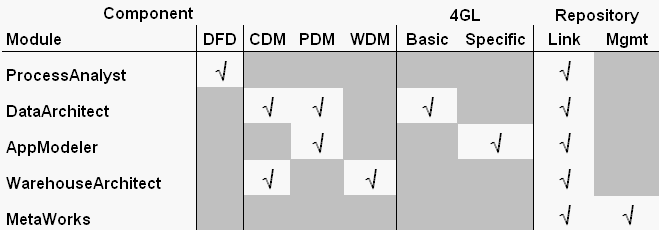
greatly at different levels. Let's dispel a common misconception. Just because Sybase owns the PowerDesigner product does not mean that this is a narrow single-vendor solution like Designer/2000 from Oracle. PowerDesigner started out life as a platform-neutral tool from an independent vendor. PowerDesigner remains equally applicable to almost any relational database back end - IBM, Informix, Ingress, Oracle, Progress, Sybase to name a few - and many client side products as well - not only PowerBuilder but also Delphi, Visual Basic, and Java. PowerDesigner is to our knowledge the broadest data modeling tool in terms of end platform support. ProcessAnalyst, despite the hint of process modeling in its name, is strictly a data flow diagram tool which feeds data discovery and definition into conceptual data models. DataArchitect starts there and carries on to generate the database, covering the great majority of functions in between as they relate to relational database design. WarehouseArchitect extends the range of DataArchitect with special wizards and DDL to support data warehouse design. AppModeler will generate client code to access and maintain data in the modeled database.
As more features are added, PowerDesigner has been partitioned into more modules offering feature sets appropriate to different layers of systems engineering tasks and teams. These modules have some overlap and are closely integrated with each other so that when all are installed they operate as one tool. The last on the list below, MetaWorks, is not a modeling tool per se but rather an administrative tool for managing models in a relational repository. |
|||||
|
||||||
|
InterfaceData Flow Diagramming in ProcessAnalyst (PAM)Data Model Methodology and ArchitectureConceptual Data Model (CDM)Physical Data Model (PDM)WarehouseArchitect (WAM)Reporting and Meta-data Access |
|||||
|
||||||
|
In
an industry (software) which prides itself today on
shipping "good enough" products - i.e., as
little quality as the market will bear, Sybase misses
even these sad new standards. PowerDesigner
code is riddled with unclear design, unfinished features,
undocumented behaviors, unreadable manuals, and unfixed
bugs. In our frequent weeks working at client sites with PowerDesigner
we generally find at least one new anomaly a day. Just
take a look at our PowerDesigner-users e-mail list or Bugs & Other PESTs. We must mention in particular MetaWorks as an example of a weak design rushed to market with fundamental design flaws and extensive code problems. In our broad experience we have not encountered anyone who uses MetaWorks as advertised for multi-user model management and sharing. It just doesn't work. There are well documented specific reasons which we would be glad to discuss in detail if you are interested. Of course no one is immune to bugs. That just reflects the imprecision of human thinking. And PowerDesigner does work on the whole. However this is not V1.0 of a new product. We, and many experienced users, wish Sybase would pay as much attention to testing as to marketing so we could pay more attention to modeling than beta testing a released product. |
|||||
|
||||||
|
Like
many mature products which have clawed up from obscurity
to success, PowerDesigner leads
in sheer breadth of features but now lags in quality
measures: reliability, consistency, usability, and
support. Meanwhile the price has steadily risen out of
the realm of a "little tool". In the two years Sybase has owned this product, they have not yet demonstrated the vision, will, or resources to raise PowerDesigner's capabilities to its potential. You get a lot for your money - perhaps more than from any competitor - but you get neither what is promised nor completely what you need to run these tasks. Would we buy PowerDesigner today with the same criteria as we did in 1993? Perhaps not. We were looking for the simplest, cheapest tool to persuade clients that some data model is better than none. Keep your eye on ER/Studio and InfoModeler, which are in that same underdog spot where PowerDesigner entered the picture five years ago. Would we buy PowerDesigner today as a complete solution? Nothing is perfect, including PowerDesigner. The old legacy choices weren't either. After all, they gave CASE a bad name. I don't think you'll go wrong with PowerDesigner but the choice is not nearly so clear-cut as it was last year. Stay tuned to this rapidly changing market ... |
|||||
|
||||||
|
PowerDesigner Users' Resources for many links and documents PowerDesigner Bugs & Other PESTs Sybase Client/Server Explorer by James Bean |
|||||
|
||||||
|
Sybase Inc. at http://www.sybase.com |
|||||
|
||||||