

published 20 Oct 1995 : 01 Jan 1996 updated
"Arity" refers to the number of entities involved in a relationship.
Most relationships are binary, having two entities involved:

Some relationships are unary, i.e. they are reflexiv or recursive,
referring from one entity back to itself:

And other conceptual relationships involve more than two entities -
three, four, or occasionally more:
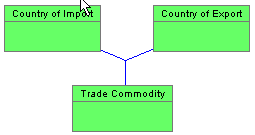
According to {Codd90} (p. 477), "The major problem with the entity-relationship approach is that one person's entity is another person's relationship." {Date95} (p.363) agrees , saying "[the ER approach] is seriously flawed because the very same object can quite legitimately be regarded as an entity by some users and a relationship by others.".
PowerDesigner addresses this issue by adopting the Information Engineering (IE) methodology from James Martin. IE reduces complex relationships to simple entity pairs. While classic Entity Relationship modeling provides for attribut on relationships, IE requires that any "relationship" which has either attribut of its own or other relationships attached to it must be simplified into the underlying entities pairs. For the same reason, PowerDesigner does not support "associative entities" as something different from any other entity; they are merely the resolution of complex relationships.
This is quite similar to the algorithmic mapping which the ORM method performs in transforming a "conceptual" model into a logical data model. Complex relationships can be described conceptually in a number of ways but they cannot be housed in current relational database structures.
While PowerDesigner's inability to capture complex relationships is consistent with its IE foundation, we feel this reinforces the character of the CDM as a "logical" model rather than a "conceptual" model.
Copyright © 1995 Applied Information Science International; 20 Oct 1995