

published 20 Oct 1995 : 01 Jan 1996 updated
Focusing on just the data components of systems architecture, we can liken the sequence to fitting a funnel over a volcano. At the top of the funnel is the random clutter of real world input - user interviews, analysts' notes, existing reports and screens, enhancement requests, vendors' offerings. From this we must discover which elements are fundamental, persistent, and applicable to our design goals. As the discovery process accelerates, perhaps through the lens of methods like data flow diagrams, ORM/NIAM, or business object analysis, structures and patterns coalesce in a tightening spiral.
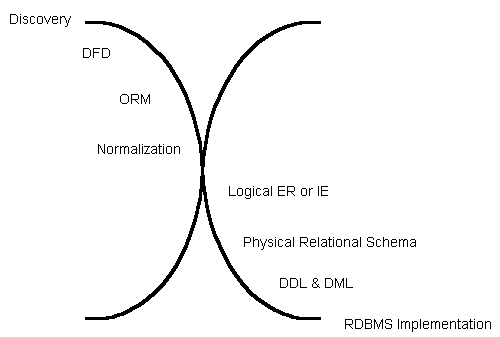
At this point, large systems design projects often resemble a black hole - every nearby resource is sucked into the maelstrom but nothing ever comes out. Successful projects mimic another aspect of the black hole as a critical state of cohesion is reached and an explosive burst of clarifying energy radiates outward; chaos crystallizes into conceptualization, which is transformed under the accelerating pressure of formal rules into a logical design and then becomes a physical model nearly automatically.
What part has PowerDesigner in this astro-physical poetry? By presenting complex data structures in their simplest abstract forms and applying its expert rules to each transformation, PowerDesigner enables the data designer to move fluidly from inspirational concept into a working database implementation, reliably, quickly, and with minimum intervention.
Copyright © 1995 Applied Information Science International; 20 Oct 1995