

 |
17 Aug 2000
Our Archived Software Tool Reviews
Software as Alchemy or Science?
Model Driven Development
Best
(and worst)
Design Practices
Relational
Design Links
and Reading List
©
©
1997-2000
Applied
Information
Science
Many forms of symbolic notation have been developed to enable data models to represent various levels of abstraction. Some are lexical, others graphic; the better approaches are both.
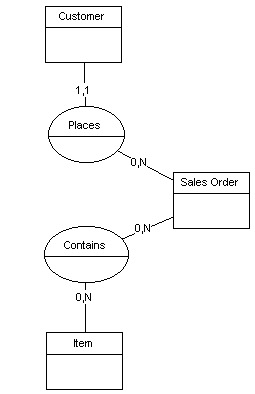 One of the earliest,
Chen's Entity Relationship Model, offers a set of shapes and lines
which, much like musical notation, deliver a wealth of
information with sparse economy of drawing. Entity
Relationship modeling was readily adopted outside
academia, introducing the concepts of data modeling to a
generation of information professionals.
One of the earliest,
Chen's Entity Relationship Model, offers a set of shapes and lines
which, much like musical notation, deliver a wealth of
information with sparse economy of drawing. Entity
Relationship modeling was readily adopted outside
academia, introducing the concepts of data modeling to a
generation of information professionals.
Chen's ER spawned a number of variations and improvements, some of which have been embodied in computer assisted software engineering (CASE) products employing ER methodology, e.g., CSA's Silverrun.
Barker90 (p. 5-1) defines an entity as "... a thing or object of significance, whether real or imagined, about which information needs to be known or held." Martin90 (vol. II, p. 219) agrees that an entity "is something about which we store data." Chen's original E-R technique made a firm (if not clear) distinction between entities, as defined above, and relationships between them. To cope with inevitable complexities, Chen allowed relationships to have attributes of their own, making them look a lot like entities and giving rise to heated debate over just what is an entity versus a relationship.
Given the lack of clarity in definitions, it is not surprising that Codd90 (p. 477) says "The major problem with the entity-relationship approach is that one person's entity is another person's relationship."Date95 (p.363) agrees , saying "[the ER approach] is seriously flawed because the very same object can quite legitimately be regarded as an entity by some users and a relationship by others." Thus Codd90 (p. 9) says emphatically that "... precisely the same structure is adopted for entities as for relationships between entities." Date95 (p.362) puts this in perspective with "[the ER approach] is essentially just a thin layer on top of the basic relational model."
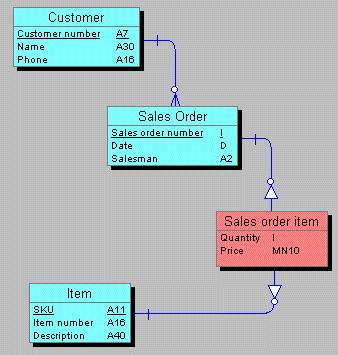 James Martin's Information
Engineering, laid out in Martin90, is a streamlined refinement on the
ER theme which discards the arbitrary notion of
the complex "relationship" with an
arity (i.e., the number of entities related) of
two, three, four, or even more. Martin models
them as simply associated entities. Thus every
relationship in IE is binary, involving two
entities (or possibly only one if reflexive).
Martin also simplified the graphic notation in
his diagram style. IE has become the basis for a
number of CASE products, including Powersoft's PowerDesigner and several others. James Martin's Information
Engineering, laid out in Martin90, is a streamlined refinement on the
ER theme which discards the arbitrary notion of
the complex "relationship" with an
arity (i.e., the number of entities related) of
two, three, four, or even more. Martin models
them as simply associated entities. Thus every
relationship in IE is binary, involving two
entities (or possibly only one if reflexive).
Martin also simplified the graphic notation in
his diagram style. IE has become the basis for a
number of CASE products, including Powersoft's PowerDesigner and several others.
|
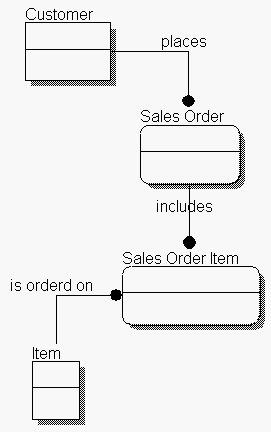 Another
common modeling technique is IDEF, developed in the late
1970's and early 1980's by Bob Brown at the Bank
of America and well described in Bruce92. IDEF was later extended by various
parties into a set of tools and standards which
were adopted by the U.S. Air Force as the
required methodology for government projects. IDEF is semantically weaker
than ER and IE and forces its practitioners into
some rather arbitrary methods which lack a sound
foundation in theory. Nonetheless it is a
workable, easily learned methodology which has
been taken up, either by choice or for government
contracts, by many modelers. LogicWorks' ERwin, Popkin's System Architect, and InfoModeler from InfoModerlers, Inc.
offer IDEF1X data modeling products.
Another
common modeling technique is IDEF, developed in the late
1970's and early 1980's by Bob Brown at the Bank
of America and well described in Bruce92. IDEF was later extended by various
parties into a set of tools and standards which
were adopted by the U.S. Air Force as the
required methodology for government projects. IDEF is semantically weaker
than ER and IE and forces its practitioners into
some rather arbitrary methods which lack a sound
foundation in theory. Nonetheless it is a
workable, easily learned methodology which has
been taken up, either by choice or for government
contracts, by many modelers. LogicWorks' ERwin, Popkin's System Architect, and InfoModeler from InfoModerlers, Inc.
offer IDEF1X data modeling products. Entity-Relationship, IDEF1X, and Information Engineering all translate business requirements into formal symbols and statements which can eventually be transformed into database structural code. Thus the modeling process reduces undisciplined, non-mathematical narrative to algebraic regularity. Early practice (see DeMarco78) when data modeling techniques were not widely known, was built on a bottom-up approach. Analysts harvested an inventory of raw data elements or statements ("A customer order has a date of entry.") from the broad problem space. This examination was frequently conducted via data flow diagram (DFD) techniques, which were invented for the express purpose of discovering the pool of data items so that their structure could be considered. Expert analysis of this pool, including various forms of normalization, rendered aggregations of data elements into entities.
Unfortunately, according to Teorey94, "The number of entities in a database is typically an order of magnitude less than the number of data elements ..." Conversely, the number of data items or attributes is one or two orders of magnitude greater than the number of entities. In approaching from discovery of the multitude of details, one has the discouraging experience of watching the work funnel into a black hole of diagrams and documents, seldom allowing the escape of an illuminating ray of understanding.Top-down, entity-based approachs (ER, IE, etc.) are more concise, more understandable and far easier to visualize than those which build up from a multitude of details. Top-down techniques rapidly fan out through the power of abstraction to generate the multitude of implementation details. Current practice therefore leans toward modeling entites (e.g., "customer", "order") first, since most information systems professionals now understand the concept of entities or tables in a relational database. Entities are later related amongst each other and fleshed out with attributes; during these processes the modeler may choose to rearrange data items into different entity structures.
While this delays the analysts' inevitable agony of populating the model's details, it has the corollary shortcoming of placing responsibility for critical structural decisions on the designers. We do not mean to suggest that professional data analysts are incapable of making such decisions but rather that their time could be better spent if the CASE tool can make those decisions - swiftly, reliably, consistently - for them.
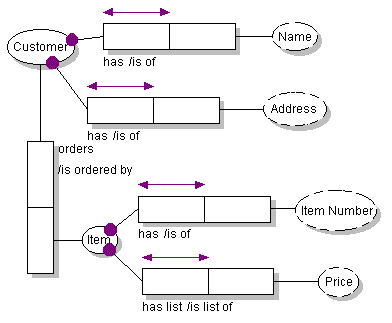 Proponents (e.g.,Halpin95) of the Object Role Modeling (ORM)
or NIAM schools represent that their
methodologies accomplish precisely that, in
addition to enabling the capture of a much larger
range of structural features and constraints than
in ER based methods. In ORM it is the calculus of
relational mapping, rather than the whim or
experience of a designer, which determines how
data items ("objects") are assembled
into entities. This does not snatch all judgment
and creativity from the designer. Rather it
elevates them to a more symbolic plane of
discussion concerning business issues and
implementation options. Dr. Terry Halpin explains
this more thoroughly and articulately in his
several articles on Object Role Modeling.
Proponents (e.g.,Halpin95) of the Object Role Modeling (ORM)
or NIAM schools represent that their
methodologies accomplish precisely that, in
addition to enabling the capture of a much larger
range of structural features and constraints than
in ER based methods. In ORM it is the calculus of
relational mapping, rather than the whim or
experience of a designer, which determines how
data items ("objects") are assembled
into entities. This does not snatch all judgment
and creativity from the designer. Rather it
elevates them to a more symbolic plane of
discussion concerning business issues and
implementation options. Dr. Terry Halpin explains
this more thoroughly and articulately in his
several articles on Object Role Modeling.
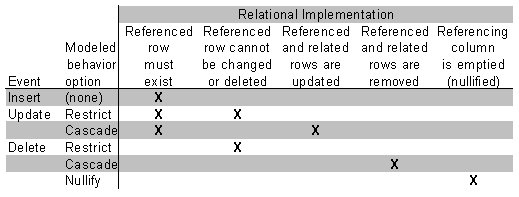
The modeling methodologies discussed above deal with conceptual and logical understanding of data but not necessarily the physical details of its storage. Additional techniques from the area of relational schema design are generally employed to represent tables, columns, indexes, constraints and other storage structures which implement a data design. For example, the table below illustrates some design choices which must be implemented in declarative or procedural integrity constraints to implement a model.
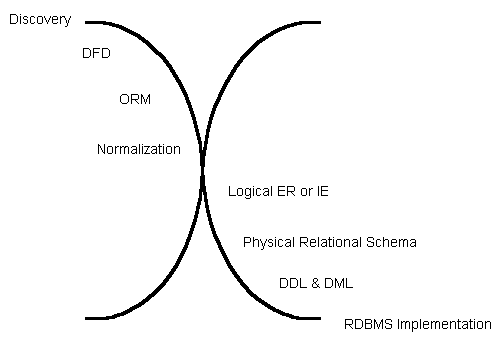
In our limited experience no single methodology, method, or tool covers the full scope of data modeling from raw discovery to instantiated database, as sketched above. Notice that in the upper half the techniques funnel downward toward coalescence and conceptual clarity (or into the black hole of bloated, aborted projects); in the lower half the process fans rapidly out as automated algorithms replicate abstract patterns to implement details (e.g., a simple foreign key reference propagates a lengthy SQL trigger).
If you are in search of the appropriate methods, skills, and tools for a large scale data design effort, keep your eyes and options open. Contact AIS for consulting assistance in evaluating, selecting, and implementing CASE techniques.